
Bio Patrice de Santa Coloma, peintre abstrait contemporain
Major Works
Three codex
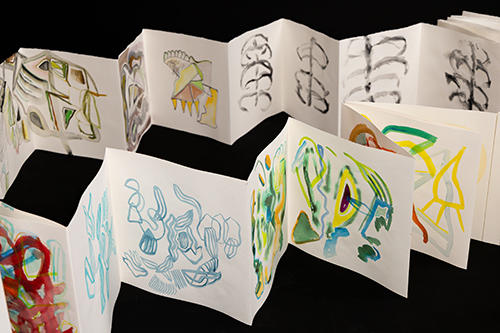
Since I started working on a project of residency in Mexico (Cosmos), I was fascinated by the Aztec codex. My research took me to the original colours they used to produce these fascinating works of art. It was not only the challenge to grind the colours to obtain the colours they used, it was more the thought of discovering how the Aztec perceived the colours and how I wanted to feel close to them by having a similar visual experience as they did. Alhtough it's a complex and impossible task as nothing can guarantee that what I'm seeing is indeed the same colour as they had seen hundreds of years back. It's fascinating to get close to that sensation. I also explored the links that the Aztecs had with the cosmos. Colors where not mainly decorative but symbolic conveying a link to nature and their mystical perception and approach to the world they had. Colour to their eyes were not static but changing moving like in perpetual transformation in the great cycle of life and death. Transition and transformation more than static and plain colors. At the center the jade green, Mayan green, to the east life, blood, below orange a red turning to the Mayan maize yellow symbol of growth. To the west of the green el ombligo del mundo, centre of the Aztec empire (the city of Tenochtitlán) is found the dark tones symbolizing death. During the residency I produced tres códices (3 codex), each having a dominant color and named after Aztecs gods. The cochineal red was the dominant color used in the Xolotl codex (Kremer pigment providing the larvae, tests carried out with Schmincke legacy formulations), then the genuine Mayan green based on Indigo chemicaly binded to paligorskyte (Daniel Smith formulation) was used in the Centotl codex. Finally the Mixcoatl codex was hand painted with bone black pigments, carbon and a lunar black a highly granulating formula made by Daniel Smith. Shades of greys, pale pinks and light earth tones were used in the codex to illustrate the purification of the ashes from carbonisation to calcination in the Aztecs beliefs of soul purifcation and perpetual cycles of life and death.
Codex dimensions: folded : 38 cm x 40 cm, open: 38 cm x 960 cm, 48 pages each, handpainted on both sides
Cosmocolor
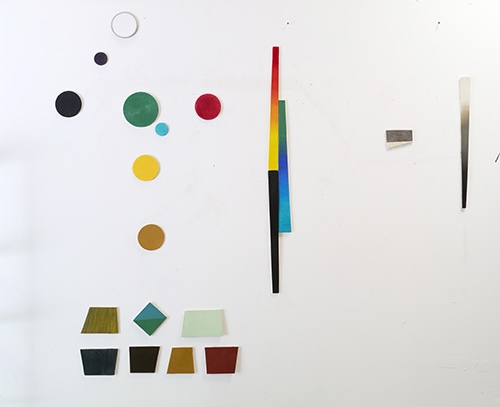
During the Cosmos residency while working on the Aztec palette and the códices I was invited by the USALP the 19th of august 2026, for a talk entitled Cosmogonía del Color where I explained my approach to colours
Below, the earths: ochre, green earth, umber and red ochre. The ground that holds everything.
At the centre, jade green: what is precious, the heart of the world (el ombligo del mundo).
To the right, red: the east, where the sun rises. Blood, life, birth.
To the left, black: the west. Night and dissolution.
Above, the white ring: breath and eternity. Purfication, calcination after carbonisation
Yellow and ochre descend towards the earth: maize, sustenance. Nourishment and
The columns: transition was the key to understand how the Aztecs percieved colours. Not static, colours were moving states, red blood life to growth and wealth symbolized by the maize yellow.
At the far edge of the cosmos, stardust, moon rays glimpses of silver and gold mixed with calcinated bones.
The wooden bars travel the spectrum of light, from red to yellow and from green to blue, ending in black.
The talk at the MUNI (Museo Universitario de San Luis Potosí) was followed by a time where I asked the audience to circle around hand painted colored discs. The discs were placed according to the Aztec's spiritual connection to the world and to the cardinal points
Genuine Aztecs pigments were used such as cochineal red, Mayan green, maize yellow, bone ash, carbon and genuine white gold guilded accents on wood as to suggest the sun rays. See my projects involving historical pigments
- Cosmocolor an installation
- Cosmocolor is an installation part of the Cosmos residency and exhibition held at the Aether Gallery in San Luis Potosí curated by Conocimiento MX
Cardinalities
In a previous series Cardinalities I had designed some large scale landscapes and imagined them as stand points following cardinal points. The north, the south, east and west (see the large scale paintings below). In a similar approach I started producing discs of pure color (like paint swatches) and organized them in space according to the Aztecs symbolic color representation. The installation was completed by wooden arrows painted with bone ash, with white gold accents. The produced piece Cosmocolor spans 3 m x 3m and consists of 10 cm and 20 cm in diameter of wooden disks.
Large scale paintings
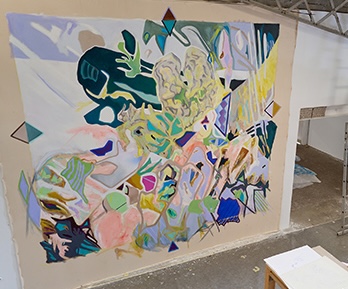
Cardinalities These large scale works are roughly 400 cm H x 400 cm W each. Executed in oil on dense coton fiber 300g/m2. The series consists of four cardinal points abstract landscapes. Each panting evocative of the four compass direction in their latin names: north (meridies), south (septentrion), east and west (two to be expeted by the end of 2029).
Pareidolia, 2026
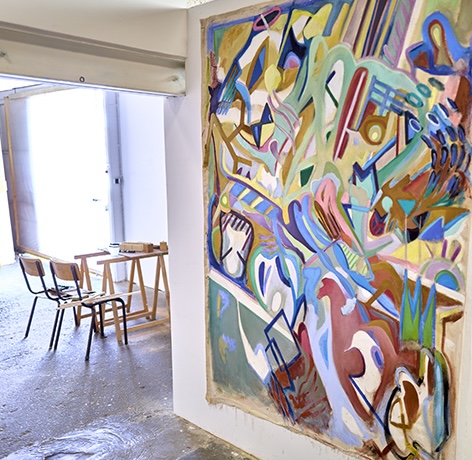
Each abstract painting of the series is 200 cm H x 150 cm W. Painting two discs in the fragmented and coloured abstract shapes attracts the viewer into a gaze as if a presence was hidden. The first two of the series were named "grande guimauve" and "Luisito"
Polyphemus series
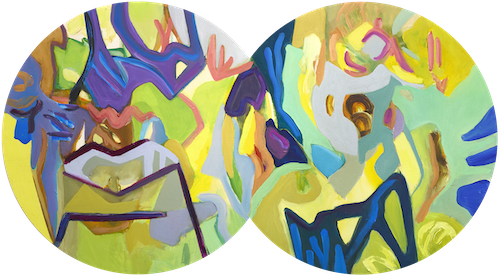
The panels explore the phenomenon of binocular vision: the way our two eyes perceive slightly different images of the same scene that are combined into a single image. This process of convergence is translated into a sequence of circular and interconnected forms. At certain stages, two circular fields appear side by side, suggesting the separate images received by each eye. As the sequence develops, these two fields progressively merge.
In a short novel I imagined a different story for Polyphemus. A solitary being, harmelss, a shepperd close to nature and his goats. I Started to evoke his resentment and retreat from the violent world. Until one day when some arrogant and omnoxious strangers enter his home and ask for food and shelter
Olympia
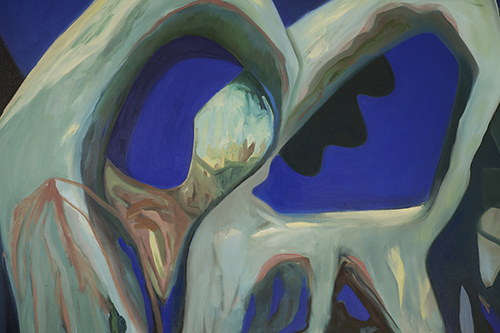
The series explores the subtle blues of the Aegan with abstract shapes evocative of underwarter worlds. It is a direct experiment with the cobalt blue deep pigment.
Diplopia series
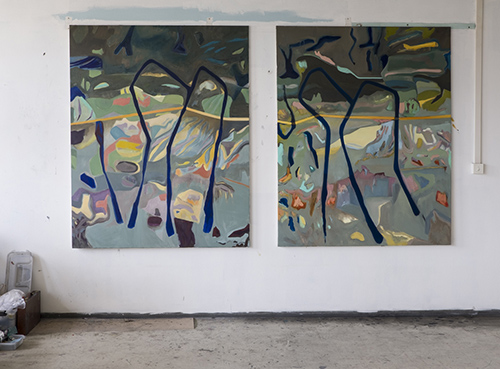
The diplopia's are dyptychs, the two paintings are similar almost identical. Each panel presented as a left eye and a right eye, giving the illusion of a binocular vision. The size of the canvases are the same for each panel of the dyptych but different sizes for the different Diplopias, ranging from 175 cm H x 140 cm W for the Diplopia I to the very large Diplopia V (250 cm H x 150 cm W, each panel) presented at the exhibition Jungle.
Telas sueltas (loose canvases), morphisms
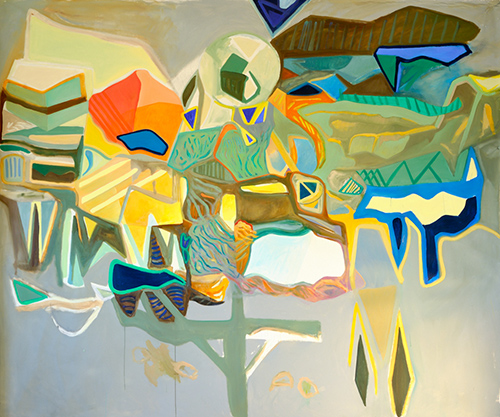
- Exhibited at the 14 rue Leyteire hosted by Emmanuel Ballangé
- A text by Corinne Szabo around the exhibition at the 14 rue Leyteire
A propos de Morphismes par Corinne Szabo. Exposition au 14 rue Leyteire chez Emmanuel Ballangé à Bordeaux
Extract: Patrice de Santa Coloma exploite un langage artistique formel particulier qui joue sur l’arabesque - figure emblématique de la corrélation entre forme et processus de croissance -, sur ses évolutions et sur son mouvement interne. Morphologiquement, ces blocs paraissent tous issus d’une même matrice et saisis à différents stades de leur évolution [...]
read full text here (french)
Campaniles
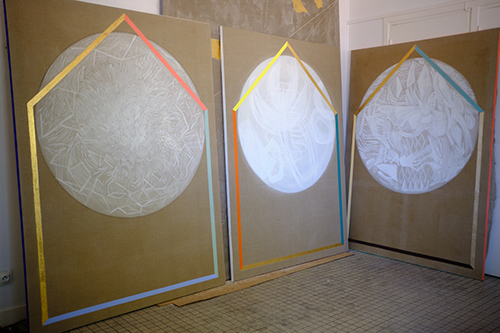
The Campanile series are part of paintings produced during and art-science residency in collaboration with the University of Bordeaux and the Bordeaux Proteom plaftorm. Egg tempera as a binding agent was used with traditionnal white pigments such as zinc oxide, lead and lithopone (zinc and barium). The science project was to investigate how a specific protein contained in the egg white such as the lyzozym creates strong bonds and make egg tempera extremely resistent to U.V. radiation
Polyptychs
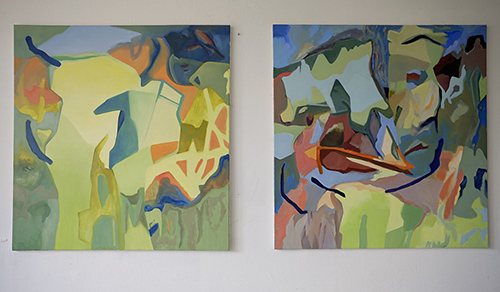
Sixteen paintings each one 110 cm H x 105 cm W, a series started in 2015 and finished in 2017. Some of the paintings were exhibited in the Andes Gallery in Riehen, Basel, Switzerland in 2019. The idea behind the series was to start off from a first painting, a matrix, and explore each 10 or so square centimeters of the painting and project it on a larger painting (like a blow up).
Social
About
news bio / contact